Tuesday, 16 February 2016

[HM:258343] 5 Ways towards Becoming Effective Project Manager

A recent study of 30+ Fortune 500 companies and nearly five hundred project managers was conducted by the CEB and it was identified that the number one driver of Project Manager effectiveness is Stakeholder Partnership. So the big question is how do you become a good partner? Below are the top 5 ways identified below based on feedback from business sponsors, PMO executives, and project management managers.


1) Trust. Earning the trust of business stakeholders is monumental. Building trust is something we learn to do early in life. The principles they teach in kindergarten are building blocks for trust. We learned to tell the truth, say please and thank you, keep our hands to ourselves, do what we say we will and treat others like we would like to be treated. Fast forward to your career in corporate America and those building blocks still apply. When you genuinely focus and work diligently to understand and deliver for your business partners then your business values and trusts you. The easiest way to earn trust is to deliver. Be able to execute and complete your projects. The truth is we all know the quagmires of project delivery. There are risks looming around every turn and issues waiting to jump up and create roadblocks for you. Establishing a good communication protocol is key to building good relations. You don't want to be known as Chicken Little who cries the "sky is falling" all the time. You have to learn when and how to communicate risks that are triggered and issues that come up. Being able to deal with issues properly, keeping composure and mitigating and handling risks when they are triggered come with experience and earn you credibility with your business partners.


2) Respect your business partners time. Another important way to score points is to efficiently use your business partners time. Spend the right time planning your meetings and make the meetings impactful. Each successive meeting that is meaningful translates into goodwill and trust earned. It also is a sign of incremental forward progress. Learn how to include the right people in the right meetings and be sure they are prepared to contribute. Learn when to communicate key information and when to elicit feedback and guidance. This is an art and should be cultivated early in the project lifecycle. Be ready and prepared to review key documentation and allow enough lead time for participants to review materials in advance. Additionally, I find scheduling a recurring 30-minute meeting each week with my key business partner goes a substantial way in sharing the right information and building the relationship.


3) Secure the right resources for project delivery. One way to earn credibility is to ensure the proper resources are secured for achieving project success. Be sure there is pause and a concerted effort with key business and technology partners to properly plan the project. Always be strategic before running to tactical. So often there is a push to begin running and executing that it is almost comical (not really) when everyone begins to wonder why things are not going more smoothly than they should. I call it running with scissors. There needs to be the right amount of energy focused on the WHAT needs to be achieved. Identifying all of the scope items and the key features and functions of each major scope item enables sizing to take place. This sizing equates to securing the right resources. Based on resource allocations, a schedule can be formed and you have your triple constraints outlined and agreed to, allowing of course for adjustments once the final technical specifications are complete.


4) Be clear and concise. It is important to convey the proper information to your business in a manner that makes sense. Preparation and practice both go a long way to being successful here. Early on in my career I was not as prepared to have discussions with executives. I would get nervous and lose concentration in those big moments. But I found that proper preparation combined with confidence by experience works wonders. I became proficient at Microsoft Power-point and creating presentation decks to clearly articulate my messages. Another trick is to actually pretend the CEO is going to be in the audience along with your other senior business and technology leaders. It forces you to think like an owner and pull the information up to the right level. Use of bullets and visuals is a great way to convey a message. Showing a timeline diagram is an effective means to discuss and demonstrate delivery over time. For example, take a complex financial spreadsheet with all estimated project costs. If you need to review this information with your sponsor for approval it makes sense to summarize this information and put it into a presentation format. This is an effective way to review and gain funding approval. Also, take the time to learn to use business terminology and become familiar with the subject matter of your business.


5) Broker consensus among stakeholders. Throughout the life of your project you will encounter many crossroads where you need a decision. It may be an issue that has presented itself. You outline pros and cons to multiple options to resolve the issue, now the hard part is gaining consensus. Certain key decision makers may not be in agreement. How do you proceed? I have found that the best place for brokering consensus is NOT in big meetings or by dropping these issues on these key stakeholders without advance notice. The first key to success is no surprises. You need to learn what topics may be sensitive and navigate accordingly. Schedule some smaller meetings to communicate in advance. In these smaller meetings you can discuss, collaborate and broker agreements before pulling into a larger meeting to formalize. This is always a best practice and you will find you have earned trust and respect of your partners along the way.


There are numerous other means to building stakeholder partnership, such as effectively communicating with your project sponsor and facilitating large stakeholder meetings, but the key point is to be focused and vested in delivering for your business. This all starts with you following some of the key tenets above and genuinely caring about positive business outcomes. The late Steven Covey described it best. No one is perfect. We will all make mistakes. But if you have made enough deposits then when you need to take a withdrawal you will not overdraft your account. Goodwill goes a long way and being long on credibility and successful delivery will serve you well.


Written by Jason Hilliard


--
--
We are also on Face Book, Click on Like to jois us
FB Page: https://www.facebook.com/pages/Hyderabad-Masti/335077553211328
FB Group: https://www.facebook.com/groups/hydmasti/
 
https://groups.google.com/d/msg/hyd-masti/GO9LYiFoudM/TKqvCCq2EbMJ

---
You received this message because you are subscribed to the Google Groups "Hyderabad Masti" group.
To unsubscribe from this group and stop receiving emails from it, send an email to hyd-masti+unsubscribe@googlegroups.com.
For more options, visit https://groups.google.com/d/optout.
Monday, 15 February 2016

[HM:258342] Business: How to Setup Telephones Lines and Why You Need a PBX (Private Branch Exchange)

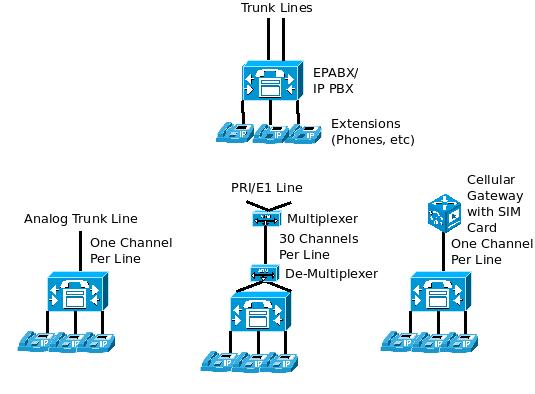
Difference between analog line, PRI/E1/T1 line and GSM/ cellular gateway

Why do you need a PBX?

we need to understand some background about what is a PBX and why we need it. PBX actually refers to Private Branch Exchange. Imagine this situation – You have 100 employees in your organization, and all of them work from their office. Each one of them need to make outgoing calls (to partners, customers, etc) and also need to talk to their colleagues.

If there was no PBX, you have to procure 100 different analog trunk lines (from a Telecom service provider) to give telephone access to all of them. They can call each other, but those calls will also be charged as they are routed from the public telephone exchange. So, obviously this method is inefficient.

So, a small private branch exchange – PBX (Telecom switch) is kept at the organization to achieve two important purposes :

1. To share the incoming (trunk) lines from public telephone exchange to all employees as every employee is not going to be making outgoing calls/ receiving incoming calls all the time. So, instead of buying a trunk line for every employee, you might just buy one line for ten employees (sufficient in most cases) and share them.

2. To make internal calls (based on extension numbers) without any charge. Since the PBX is a mini-switch, it can route calls from one extension to another extension internally.

Analog Trunk Lines:

The phone line (land-line) that you get in your home is an example for an analog trunk line. At homes, one line would suffice. But in organizations, multiple such lines might be required (as the number of telephone users are more). These analog trunk lines carry a single channel of voice call per line (meaning, one person can make or receive a phone call from outside at any given point of time).

For terminating the analog trunk lines in a PBX, special analog trunk cards (12 ports, 24 ports, etc) are used. In an IP PBX, Analog Terminal Adapters (ATA) or PCI based Analog Cards may be used. These devices convert the analog calls into IP so that an IP PBX can understand them and transmit them over the network.

Separate rental / call charges needs to be paid for each analog trunk. Analog trunk lines are sufficient for small organizations which require a few lines.

PRI / E1 / T1 Lines:

For larger organizations that require a lot of trunk lines, procuring additional analog trunks might not be a practical idea as they need to buy separate (perhaps multiple) analog trunk cards to terminate these lines in their PBX (and) they need to pay separate rental for each line where the free call capacity for some individual lines might never be reached!

So, these organizations can procure a digital line called as PRI/ E1 (In Europe/ Asia) or T1 (In America). Each PRI / E1 line can carry up to 30 channels of voice communications simultaneously. They can do this by using multiplexing/ de-multiplexing techniques (at the public telephone exchange end -and- the customer PBX end). A T1 line, similarly can carry up to 24 channels of voice communications simultaneously.

At the customer end, they need to procure a PRI / E1/ T1 Card, to terminate this PRI/ E1/ T1 line in their PBX. Just imagine – One line coming into your organization but thirty people can simultaneously make or receive calls through it! And add to it a single consolidated rental / billing package from the Telecom company. You can read more about PRI lines and its advantages from here.

There is another type of digital line called ISDN line. With ISDN, two simultaneous calls can be made/ received at the same time using a single line.

GSM/ Cellular Gateway:

In some situations, it may not be feasible to lay analog lines (over a hill, rural areas, etc). But those places might be covered by cellular companies/ signal from cell phone towers. In such situations, you can use a GSM / CDMA Cellular gateway device called as Fixed Cellular Terminal and use the Cell phone SIM cards as analog trunks for your PBX. These devices are in fact connected to the analog trunk ports of the PBX.

A Fixed Cellular Terminal is a small device in which you can insert a SIM card and connect the single-pair copper telephone cable coming out of it, directly to a telephone (or) to a PBX. At the other end of the PBX, the extensions (normal phones) are connected. So, when someone makes an outgoing call, the request reaches the PBX and the call is directed to the Cellular Gateway which has the SIM card. Some cellular gateways have multiple SIM cards, enable multiple simultaneous calls to/from outside.

So, even though people might dial a number from their land line extension, the call actually goes through the cellular network using the GSM/ CDMA Cellular Gateway.

VOIP / SIP Trunks:

Of late, VOIP service providers have become very popular. They use the Internet backbone (mostly) to transmit the call as IP packets to the destination. They have gateways (where required) to convert the IP calls to analog calls before passing them on to the local telephone exchanges so that people can reach normal landline/ cell phone numbers using the VOIP Service. You can read more about SIP Trunks from here.

excitingIP.com

You could stay up to date on various computer networking/ related IT technologies by subscribing to this blog with your email address in the sidebar box that says, 'Get email updates when new articles are published'

--
--
We are also on Face Book, Click on Like to jois us
FB Page: https://www.facebook.com/pages/Hyderabad-Masti/335077553211328
FB Group: https://www.facebook.com/groups/hydmasti/
 
https://groups.google.com/d/msg/hyd-masti/GO9LYiFoudM/TKqvCCq2EbMJ

---
You received this message because you are subscribed to the Google Groups "Hyderabad Masti" group.
To unsubscribe from this group and stop receiving emails from it, send an email to hyd-masti+unsubscribe@googlegroups.com.
For more options, visit https://groups.google.com/d/optout.

Sunday, 14 February 2016

[HM:258341] Personal Affirmations - Empower Your Inner Dialogues

Put A Positive Spin On Your Inner Dialogue
 
 
If you were able to read a transcript of your inner dialogue - that seemingly ceaseless chatter that fills our head - what would it say about your relationship with yourself? Friend or foe? When you face a major challenge, does the voice say "you can do it!" or does your internal critic kick in?
 
Directing your awareness to your self-talk can help reveal a hidden habit of self-defeat. Making a few adjustments to the dialogue can help empower you to break old patterns, overcome obstacles and put a positive spin on your outlook. Positive affirmations are the antidote. Would professional athletes make it to the finish line by telling themselves "you can't do it?" Encouraging, optimistic mental conditioning is integral to your success.
 
You are in charge of your thoughts, simply change the channel, turn the page, send the negativity into outer-space and replace them with more valid and useful words of wisdom. Developing your own positive affirmations is easy, just look at the truth. Allow yourself to focus on your true basic goodness and make a list. Are you creative? Generous? Helpful? Intuitive? If you are trying to lose weight, turn your finances around, or learn to speak Japanese, the truth of the matter is that you can do it. It is physically possible. So just tell it like it is.
​​
"I can do it."
 
If you need help developing affirmations, browse Louise L. Hay's books or card decks, which are filled with good ideas like "I accept all parts of myself," "I am surrounded and filled with infinite wisdom," or "I am willing to go to a new level to truly heal myself."
 
Once you have a few powerful messages for yourself you can:
  • * Repeat them several times during the day, especially at night before going to bed and after getting up in the morning.
  • * Post them around the house - on mirrors, doors, your alarm clock.
  • * Create a stack of note cards and pick one out to contemplate each day.
  • * Choose one and write it one hundred times in a notebook.
  • * Write them into your subconscious so that the positivity is with you always.
  • * Allow yourself a moment to truly experience positive feelings.
  • * Refresh your affirmations every two weeks so the message doesn't become stale.
  • * Remember to be patient. "It takes some time to go from a seed to a plant", says Louise Hay, "and so it is with affirmations, it takes some time from the first declaration to the final demonstration.


--
--
We are also on Face Book, Click on Like to jois us
FB Page: https://www.facebook.com/pages/Hyderabad-Masti/335077553211328
FB Group: https://www.facebook.com/groups/hydmasti/
 
https://groups.google.com/d/msg/hyd-masti/GO9LYiFoudM/TKqvCCq2EbMJ

---
You received this message because you are subscribed to the Google Groups "Hyderabad Masti" group.
To unsubscribe from this group and stop receiving emails from it, send an email to hyd-masti+unsubscribe@googlegroups.com.
For more options, visit https://groups.google.com/d/optout.

Saturday, 13 February 2016

[HM:258340] Excel: Interactive KPI Dashboard

Interactive KPI Dashboard
  

Slicers is a very useful but underutilized tool in Excel. You can dynamically filter your pivot tables and pivot charts with animated buttons, aka slicers. For more information on slicers, you can check this short article.

Now let's see how to build an Interactive KPI Dashboard using pivot table tools:

I prepared a summary data for 4 departments; welding, cutting, assembly and packing. KPI's for these 4 departments are selected as efficiency, productivity and scrap rate. Data set includes values for 12 months (4x3x12=144 rows). Here is how data set looks:Interactive Procution KPI Dashboard 1

Select all the data and insert a pivot table. Arrange fields as shown below (Don't look for Rest field at this point. We are going to add it in next step):Interactive Procution KPI Dashboard 2

Click on the pivot table to activate it and add a calculated field from the menu shown below:Interactive Procution KPI Dashboard 3

Set calculated field parameters as shown below and we will have an additional field in our pivot table to use for our charting needs:Interactive Procution KPI Dashboard 4

Set KPI filter as "Productivity" and make 2 copies of the pivot table (by copy and paste). Set KPI filter for those tables as "Efficiency" and "Scrap Rate". Here is how it is supposed to look:Interactive Procution KPI Dashboard 5

Insert a donut chart for each of these pivot tables. Cut them and paste them to another sheet. Format your charts to look like this:Interactive Procution KPI Dashboard 6

To do this, right-click on any gray button on the chart and select "Hide All Field Buttons on the Chart". Delete chart title and legend. Then click on the donut and set shape outline to "No Fill". Set shape color separately by clicking on them and selecting color.

Now make another copy of the first chart and arrange fields as shown below:Interactive Procution KPI Dashboard 7

When finished, make 2 copies of this pivot chart too:Interactive Procution KPI Dashboard 8

Now merge 3 cells and type "=B5" (without bracelets). B5 is the cell that contains result value of first pivot table (you can see from previous picture). Make sure to disable gridlines here. Then select your merged cell and copy it. Then paste it, as linked picture, to the sheet that has your donut charts. And drag it over related chart.Interactive Procution KPI Dashboard 9

We are finished our donut charts at this point. It is time for our column charts. We need a 3 column data table for each of our column charts. Here is how I do it:

Place a 3 column grid just under the second set of pivot tables. First row will contain column titles. First column will contain month names. Remaining 2 columns will be filled by formulas. Here are the formulas:

Result Column Formula:

=SUMIFS(Sheet1!$E:$E;Sheet1!$A:$A;Sheet2!$A$14;Sheet1!$B:$B;Sheet2!$B$11;Sheet1!$D:$D;Sheet2!$A20)

This formula fetches result values based on department and KPI values selected on the pivot table above and month name in first column. You can see how to use this function from here SUMIFS FUNCTION.

Selection Column Formula:

=IF(A20=$A$15;B20;NA())

This formula checks selected month on the pivot table above and shows result value from 2nd column if month matches. If it doesn't match, it shows #N/A.

Here are the tables I prepared:Interactive Procution KPI Dashboard 10

Now select first table and insert a column chart. For formatting:

  • Double-click on the orange column and set is as secondary axis.
  • Set Series Overlap and Gap Width to 100%
  • Delete both axes, chart title, legend and grid lines.
  • Change column colors and set Shape Outline for the chart as "No Fill"

Here is how your chart should look like after all these make-up:Interactive Procution KPI Dashboard 11

Do the same for other tables (other KPI's), you can also copy chart formatting to do this faster. Then place these chart next to your donut charts:Interactive Procution KPI Dashboard 12

Now comes the interactivity part. Click on your first donut chart and insert a slicer from INSERT ribbon. Select Month Name as field. Make sure settings are made as shown below:Interactive Procution KPI Dashboard 13

You should check whether your slicer works correctly, by clicking on its buttons. If it doesn't change charts, it is most likely because of report connections. You can correct this issue from there. Insert slicer for other KPI's (chart pairs) too.

Now customize you slicers as a 3×4 button grid with button height and width as 1,2cmx1,2cm. Change colors to match with your charts. You can see how to do this from Customize Slicers. Here is how it should look like:Interactive Procution KPI Dashboard 14

Add a final slicer for departments. You can do this by clicking on any of the charts and inserting a slicer. This slicer must be connected to all pivot tables.

Place it on top of your charts, add KPI texts over slicers and our dashboard is done.

You can download this Interactive KPI Dashboard from the link below:

Download Interactive KPI Dashboard

--
--
We are also on Face Book, Click on Like to jois us
FB Page: https://www.facebook.com/pages/Hyderabad-Masti/335077553211328
FB Group: https://www.facebook.com/groups/hydmasti/
 
https://groups.google.com/d/msg/hyd-masti/GO9LYiFoudM/TKqvCCq2EbMJ

---
You received this message because you are subscribed to the Google Groups "Hyderabad Masti" group.
To unsubscribe from this group and stop receiving emails from it, send an email to hyd-masti+unsubscribe@googlegroups.com.
For more options, visit https://groups.google.com/d/optout.

Thursday, 11 February 2016

[HM:258339] How to Network When You're an Introvert

Join us in a city near you at Entrepreneur's Accelerate Your Business event series kicking off Feb 23. View cities and dates »

In today's workplace environment, we use more technology than ever before.  As new businesses become more technology and information driven, the quieter an office becomes.  How do we set ourselves apart in a world full of successful and smart introverts?

We become great at networking.

The advice to reach out to others in order to improve the outlook of your business is well-known, but for those who are introverted, it's much easier said than done. Even if you feel that your strengths lie in being a player behind the scenes, you can still benefit from networking. Here's how to do it as painlessly as possible:

Network and make connections online

Connecting with people online before you meet them can be really helpful.  Connect with other event attendees on LinkedIn, Twitter, Facebook and social media platforms before an event. Connecting prior to meeting allows for you to feel less alone when you arrive. Familiar faces, even if they belong to a stranger, can be really comforting.  You can also use this to find new events by connecting with people who are a part of or work at organizations that you belong to.

In my role as Assistant Director, Alumni Marketing and Communications at the Harvard Business School (HBS), we stay connected with alumni through four social media channels -- Twitter, Facebook, LinkedIn, and Instagram. -- Robert Bochnak, Harvard Business School

Talk about your accomplishments

This one is hard for introverts. By definition, introverts often stay in the shadows and seldom celebrate their achievements publicly. It's not a bad thing to let people know what you've done and what you've accomplished – and talking about these achievements can help you to make connections that you are able to help.

Discuss your goals and ideas

There's no need to prattle on about 100 different ideas that are floating through your head, but if you're looking for something to talk about when you meet someone in the industry, bring up an opinion that you have or an idea that is specific to your industry to jumpstart the conversation.  Ask the person what their goals are and take time to see if you know anyone that could help them. Sharing your connections is a great way to gain new strong connections.

Don't overthink it

When you go home, leave your interactions and networking attempts alone emotionally. No need to go over and over what you said, how the other person responded, or whether or not you were well received. Even if you feel like you made a few social blunders, don't dwell on it. Concentrate your energy on the positive things that came out of your networking attempt and let your mistakes inform your choices next time.

Maintain strong relationships

Every so often, you'll make a strong connection, and when that happens, it will help you with your networking to maintain that connection and create a solid relationship. This person may be likely to speak up on your behalf, introduce you to others, and make your networking easier. This goes both ways. Make sure to speak for your other connections and listen for opportunites for them as well.

Takes notes

It's important to remember the faces and names of the people you meet after attending a networking event. When someone hands you their card, look at the card and then at them.  When they walk away, type a small note into your phone or on a notepad so that you can remember them later.  After the event, send an email to them and let them know that you enjoyed meeting them.

Networking is dificult for anyone and for introverts, it can be painful. However, as you start to make connections, the benefit will soon outweigh the work. Do you have any additional tips? 

Source: entrepreneur

--
--
We are also on Face Book, Click on Like to jois us
FB Page: https://www.facebook.com/pages/Hyderabad-Masti/335077553211328
FB Group: https://www.facebook.com/groups/hydmasti/
 
https://groups.google.com/d/msg/hyd-masti/GO9LYiFoudM/TKqvCCq2EbMJ

---
You received this message because you are subscribed to the Google Groups "Hyderabad Masti" group.
To unsubscribe from this group and stop receiving emails from it, send an email to hyd-masti+unsubscribe@googlegroups.com.
For more options, visit https://groups.google.com/d/optout.

[HM:258338] The Maid and Pizza


A lady to her husband: Avoid giving too many clothes for laundry.

Husband: What happened?

Wife: The maid won't be coming for work for a couple of days.

Husband: Why?

Wife: She's going to see her granddaughter over to her daughters place over the holidays.

Husband: Alright, I'll keep that in mind.

Wife: Before I forget, how about we offer her a festive bonus? Rs. 500?

Husband: But why? Diwali is around the corner, why don't we just give her the money then?

Wife: Oh, no… She's a poor lady, works as a domestic help. She's going to see her daughter. With her meagre income, how would she be able to enjoy a good holiday? Poor thing!

Husband: There you go! Getting overly sentimental again!

Wife: Don't worry about the money; let's cancel our plan for pizza for dinner tonight. No point wasting money over eight slices of stale bread.

Husband: Great! So now we have to give up on our pizza night so the maid can get a bonus?!

Three days later, when the maid is back at work, the lady's husband asked her.

Husband: So, how was your holiday?

Maid: It was wonderful, sir. Didi had given me 500 as a festive bonus that added to the joy.

Husband: I heard you went over to your daughters place. Met your granddaughter?

Maid: Yes, sir. I had such a great time. We spent 500, all of it in just two days.

Husband: What did you buy with that money?

Maid: I bought my granddaughter a shirt for Rs. 150 and a doll for Rs. 40, sweets for my daughter and to offer at the temple for Rs. 50, each, spent Rs. 60 on the rent, bought my daughter bangles for Rs. 25, and a nice belt for my son in law for Rs. 50. We spent the rest of the money buying notebooks and stationery for my granddaughter.

Husband: All that for Rs. 500?

In a shocked state he started thinking and seeing pizza in his head.

Each piece of the pizza started buzzing in his head. He started comparing the pizza's price with the maid's festive expenses over her family.

He started imagining each piece of the pizza as different things she bought for her family like kids dress, sweets, rent, the bangles she bought, the belt she bought for her son in law, the books and pencil she bought.

He had only imagined the delicious part of the pizza, he had never thought of the other plain and dry part of it and today because of his maid he could understand the other part of the coin or the pizza. A simple 8 pieced pizza taught some reality of life.

​​

This incident made him realize the meaning of "Spending to live not live to spend".

--
--
We are also on Face Book, Click on Like to jois us
FB Page: https://www.facebook.com/pages/Hyderabad-Masti/335077553211328
FB Group: https://www.facebook.com/groups/hydmasti/
 
https://groups.google.com/d/msg/hyd-masti/GO9LYiFoudM/TKqvCCq2EbMJ

---
You received this message because you are subscribed to the Google Groups "Hyderabad Masti" group.
To unsubscribe from this group and stop receiving emails from it, send an email to hyd-masti+unsubscribe@googlegroups.com.
For more options, visit https://groups.google.com/d/optout.

Wednesday, 10 February 2016

[HM:258337] Interview Questions You Should Never Answer

Most of the questions asked in an interview are off-limits. Being a candidate, it is not essential to get ready for the questions employers tend to ask you, but also to be prepared in order to shirk the questions that do not deserve an answer.

1. How old are you?
You're not required to justify any questions related to your age except than just determining that you are above 18 years. There's also no need to provide a photo ID during the interview session. In case, if this question is posed then you can simply state that you're afraid of identity theft and would not opt to hand over the concerned document until it's firmed that you will be joining the team or not.

2. What's your nationality?
Same goes with this particular question, you need not answer the questions posed over your nationality, citizenship status or as in for how long you have been residing in the US or any other country. Just illustrate that you're officially capable to work in the country.

3. Are you married? Do you have any children?
Interviewers have the authority to ask you whether you have made use of alternate name professionally or while your academics, but they are not authorized to ask you about your marital status, children or in case you decide to have a family in the foreseeable future. In such circumstances, readdress the question back to the interviewer.

4. Do you have any spiritual beliefs?
Questions related to religious ideas are beyond limits while an interview, getting your religious fundaments and what religious holidays you noticed. If the interviewer pose this question, then try to find out what they are alarmed with and then tackle those concerns.

5. How long would your commute be to this office?
The recruiter should not ask you questions about the residence you stay from the office , as in how far it is, he can try to find out whether you can start the work at a certain hour or displace from the position. If your planning to relocate due to the post, then straight-away mention the same in your professional summary on your resume as well as online profiles that you desire and able to transfer ASAP.

jobinterviewtipz


--
--
We are also on Face Book, Click on Like to jois us
FB Page: https://www.facebook.com/pages/Hyderabad-Masti/335077553211328
FB Group: https://www.facebook.com/groups/hydmasti/
 
https://groups.google.com/d/msg/hyd-masti/GO9LYiFoudM/TKqvCCq2EbMJ

---
You received this message because you are subscribed to the Google Groups "Hyderabad Masti" group.
To unsubscribe from this group and stop receiving emails from it, send an email to hyd-masti+unsubscribe@googlegroups.com.
For more options, visit https://groups.google.com/d/optout.