Thursday, 8 December 2016

[HM:258552] Keep Your Teeth: How to Develop the Habit of Flossing

Keep Your Teeth: How to Develop the Habit of FlossingAs someone once said, "Only floss the teeth you want to keep." But flossing is about much more than oral health. While flossing is a simple activity that only takes a minute, it's a habit that many people find challenging to implement.

The bacteria in your mouth are a cause of heart valve damage and general inflammation throughout the body. That's why the dentist prescribes antibiotics before any significant dental procedures. It's to protect your heart!

Since it's so important to your health, it's worth the effort to make flossing a permanent part of your oral hygiene routine.

These are the steps to make it happen:

1. Determine when you'll floss. This is the easiest part. The only time that really makes sense is immediately before or after you brush your teeth. So, your toothbrush serves as the trigger point.

2. Have visual reminder, too. Just in case your trigger point doesn't remind you to floss, it's good to have a backup reminder. Put a note on the bathroom mirror or put the floss out where you have to see it.

3. Start with just one tooth. It sounds silly, but it works. The thought of flossing all of your teeth might seem like too much work, but flossing one tooth is so simple and easy that you'll just do it.

  • Over the course of a few days, add in your other teeth one or two at a time.
  • You'll find that if you can just do one tooth, you're likely to keep on going and do them all.

4. Try to enjoy it. If you focus on the fact that it's boring or annoying, you're going to be miserable for 60 seconds. But you can choose to focus on how you're getting your teeth nice and clean and doing something important for your health.

  • A simple task that has so many benefits becomes easy to enjoy.

5. Mark your calendar. Put a big X on the calendar every time you remember to floss.

6. Remember that you're setting an example for your kids. Of course, you want them to floss. Remember that they're always watching you. If you're not modeling flossing, they're not going to floss either.

7. Educate yourself about all the health benefits. Do a quick search online and educate yourself about all the health benefits of flossing. You'll be amazed.

8. Assume the worst will happen if you fail to floss. While it's always preferable to feel compelled to perform an action for the benefits, sometimes using pain or a negative image can be a stronger motivator.

  • If you can't seem to get into the flossing habit, consider visualizing the worst that could happen if you're not flossing. Imagine your teeth turning brown and falling out. Think how others might be uncomfortable and repelled by your appearance.
  • Now imagine flossing your teeth and having nice, clean, white teeth.

9. Hang in there. It will take about 30 consecutive days of flossing to build the habit and keep it. You simply have to be diligent and floss every day, even if you're not feeling like it. It's only a minute of your time. You can do it!

That's all there is to it. In a few short weeks, you can be flossing every day and doing something wonderful for your teeth and your overall health. Something simple, like flossing, can be a powerful springboard to developing other worthwhile health habits, too.

By showing yourself that you can floss every day, you'll begin to believe that you can control other aspects of your behavior. Flossing is a simple task that can have profound, positive effects. Make the effort and you won't regret it!

Keep Your Teeth: How to Develop the Habit of Flossing appeared first on My Self Improvement Daily.

--
--
We are also on Face Book, Click on Like to jois us
FB Page: https://www.facebook.com/pages/Hyderabad-Masti/335077553211328
FB Group: https://www.facebook.com/groups/hydmasti/
 
https://groups.google.com/d/msg/hyd-masti/GO9LYiFoudM/TKqvCCq2EbMJ

---
You received this message because you are subscribed to the Google Groups "Hyderabad Masti" group.
To unsubscribe from this group and stop receiving emails from it, send an email to hyd-masti+unsubscribe@googlegroups.com.
For more options, visit https://groups.google.com/d/optout.

Monday, 5 December 2016

[HM:258551] Chen Si - Saving People from Suicide

A man named Chen Si dedicates every weekend of his life at China's Nanjing Yangtze River Bridge (the World's #1 suicide site) and saves people from jumping. He has saved 321 people in 13 years. Chen Si rents a two-bedroom flat so that those in need could have a place to stay after being saved from the bridge. The flat costs 1,000 yuan ($145) a month. Two-thirds of the cost is covered by donations and Chen pays the rest. With a monthly salary of 4,000 yuan ($578), he spends half of the money on his volunteer work and hands the rest to his wife.


​Source: LinkedIn

Junaid Tahir 
www.DailyTenMinutes.com

Follow me on Twitter View my profile on LinkedIn Like my page on Facebook Read my articles on my personal blog Subscribe to my Feed Visit my Google+ Page

--
--
We are also on Face Book, Click on Like to jois us
FB Page: https://www.facebook.com/pages/Hyderabad-Masti/335077553211328
FB Group: https://www.facebook.com/groups/hydmasti/
 
https://groups.google.com/d/msg/hyd-masti/GO9LYiFoudM/TKqvCCq2EbMJ

---
You received this message because you are subscribed to the Google Groups "Hyderabad Masti" group.
To unsubscribe from this group and stop receiving emails from it, send an email to hyd-masti+unsubscribe@googlegroups.com.
For more options, visit https://groups.google.com/d/optout.

[HM:258550] 12 Things That Happened To The Kids Growing Up In The Digital Age…

Kids growing up now have great fun and learning experiences with new technology such as iPods, iPads, cell phones, skype, and podcasts. But, alarmingly, they are missing out on a whole range of learning, social interaction, physical activities, and emotional intelligence skills. Let me tell you what has happened to these kids. You cannot say you were not warned!

1. Kids are not playing outside anymore

More and more children are playing inside and are attached to their devices, computers, and video games. The UK government has got alarmed about the drop in the numbers of kids playing normal childhood games in the open air.

They have invested over £300 million to encourage teachers to do more sport in schools. They also want more kids to play games like hide-and-seek and hopscotch. The benefits are enormous as kids will be healthier, happier and less prone to obesity.

At the moment, about 33% of boys are not getting the recommended daily hour of exercise. The Play England site has loads of ideas on how to reconnect children with nature.

2. Kids are not learning through face-to-face interaction

How does a baby learn to express and judge emotion? How do they start to learn language? They do it by watching their parents' facial expressions and they begin to become social creatures, acquiring essential skills which will be vital when they start playgroups and schools. But guess what is happening? The parents are increasingly absorbed in their electronic devices and cannot be bothered to even look, smile or coo at their own children! Watch parents in a café and you will see what I mean.

The alarm was raised by several paediatricians. One of these, Dr. Jenny Radesky, actually carried out a study of 55 groups of parents while they were eating at fast food joints. She and her researchers spent a whole summer doing this. She does not claim that the study has been done scientifically but has just observed what is going on. Needless to say, she is urging parents to put away their smartphones and give their children some attention. It will be vital for their development.

3. Parent-kid relationships are negatively affected

The digital parents are opting out of parenting and this is unfair to the children. The use of devices was also having a very bad effect on the way the parents actually interacted with their kids. There was a lot of negative, harsh interaction when it actually took place. It also made parents more cranky.

This is mentioned by Dr. Wendy Sue Swanson of Seattle Children's Hospital in her blog. She recommends that making boundaries for use of digital devices is very important, so that real parenting can be done. She also says that both kids and parents should take digital breaks together.

4. Kids' reading ability may be affected

There is not much research on this. But one initial study done by the Schugars of West Chester University suggests that the kids reading comprehension could be negatively affected. Their study showed that the kids who read paper books were better at comprehension than those who were using only ebooks. Kids on ebooks were inclined to skip the text and concentrate on all the interactive visual features such as popups. The best solution would be to encourage kids to read more paper books.

5. Kids have never played board games

Kids are online most of the time. Figures show that this has jumped by 38% since 2009. Whatever happened to those board games? Look at all the benefits a child gets, when you play together:

  • Child learns vocabulary, counting, math, reading
  • You can bond with him or her
  • Child learns about turn-taking, winning and losing
  • She or he can gain confidence, builds self esteem
  • Satisfies competitive urges
  • Increases attention span and focus
  • Helps concentration

While many games and apps on smartphones are also good at building some learning skills, they can never replace the human interaction.

6. Kids do not know what real friendship means

When we grew up, we had friends, real friends. Virtual friends did not exist. Look at today's teems who can count up to a few hundred friends on Facebook. The problem is that they have never seen most of them and they only know them very superficially through a virtual friend of a friend. Staying connected is great and today's teens send an average of 3,000 texts a month.

But it seems that the concept of friendship and intimacy is being irrevocably changed and this will impact relationships later on. Studies at UCLA show that digital bonding is considerably less than real face-to-face interaction.

7. Kids are losing their creativity

Trevor Baylis, the famous inventor of the wind up radio, fears that children are not getting the hands on experience that he got when he was a boy. This is affecting their creativity. He learned about putting things together by playing with a Meccano set or by building model aeroplanes and so on. Few kids now never get their hands on games like this. Everything is done for them.

8. Kids are not learning empathy

Being tolerant, caring and controlling your emotions are life skills that will serve you well. But the digital era kids are not learning any of these skills at all. You cannot empathize with a device, at least, not yet! The best way is to play with other kids and to learn about sharing, turn-taking and giving. No, I don't think there's an app for that yet!

9. Kids' scores in math and reading are not increasing

Look at what is going on in the Kyrene School District. They have invested over $33 million on updating classroom technology. Students get to create Facebook pages based on Shakespearian characters. Some choose song tracts and rapper tunes to match the mood of a character in a play or novel. It is all innovative and very exciting. The only problem is that the test scores in math and reading in this school district have remained just the same as in 2005 when there was no high tec in the schools.

10. Kids are getting no input on values and attitudes

The lack of real social interaction with parents and peers means that there is less and less time spent on teaching core values such as tolerance, kindness, honesty, diligence and respect. The devices are great for some learning activities but the parent-child relationship is becoming tenuous.

11. Kids are losing sleep

Dr. Kimberley Young, Director of the Center for Internet Addiction Recovery, has warned that children may lose track of time while they are online. This has serious consequences for doing household tasks and chores. It also affects their mood and they become irritable when they are forced to switch off. One of the most serious aspects is loss of sleep because this impacts on schoolwork the following day.

12. Kids need supervision

Parents should be on the alert for any sort of online addiction. They themselves have to set the example and make sure that there is a balance between more traditional games and online activities. A happy balance can be achieved with these tips:

  • Use Skype together to bond with grandparents
  • Play video games together
  • Negotiate digital break times where both parents and kids switch off all devices
  • Encourage outdoor activities when possible

Digital media is here to stay. They are great learning and entertainment tools but they need to be used with caution and not at the expense of real face-to-face interaction.

Featured photo credit: mzacha via morguefile.com

Love this article?

--
--
We are also on Face Book, Click on Like to jois us
FB Page: https://www.facebook.com/pages/Hyderabad-Masti/335077553211328
FB Group: https://www.facebook.com/groups/hydmasti/
 
https://groups.google.com/d/msg/hyd-masti/GO9LYiFoudM/TKqvCCq2EbMJ

---
You received this message because you are subscribed to the Google Groups "Hyderabad Masti" group.
To unsubscribe from this group and stop receiving emails from it, send an email to hyd-masti+unsubscribe@googlegroups.com.
For more options, visit https://groups.google.com/d/optout.

Monday, 28 November 2016

[HM:258549] Learning to Control Your Emotions

Learning to Control Your Emotions

Some of us have great control over our emotional responses, and some of us struggle. Doing or saying the wrong thing in the midst of an emotional meltdown could have very negative effects. Say something your boss doesn't like and you could be out of a job.

Gain control of your emotions with these strategies:

1. Realize that negative emotions simply don't last. If you're angry about something right now, you'll probably be over it by next year, next week, or even by tomorrow. But emotions tend to focus our attention right here and now. We don't consider the potential long-term consequences that a temporary emotional state can create.

  • Who hasn't done or said something in the heat of the moment that's caused great remorse? Your anger, fear, resentment, or other negative emotion will fade quickly enough. Your rash response may not.

2. Examine your emotions. Learn to notice when you're getting emotional. When you notice yourself reacting strongly, ask yourself why. Try to label the emotion.

  • Analyze why you're feeling that particular emotion and then admit it to yourself. This way, you can avoid rationalizing your behavior, which is a nice way of saying "lie to yourself." If you know the real reason you're feeling the way you do, you're more able to do something about it.

3. Create space. Many of the challenges created by our emotions could be eliminated if we could just take a moment before reacting. Getting upset isn't something that happens to us. It's something we do to ourselves, and some of us are very good at it.

4. Find a role model. Would you take stock tips from a homeless man? Probably not! Learn emotional control from those that maintain their composure regardless of the circumstances.

  • When you find such a person, ask them how they do it. The answers you receive could make all the difference.

5. Find a healthy way to release negative emotions. Our actions can influence our moods. If you're feeling bored while watching TV, there's no reason to continue watching TV. Immediately get up and go for a walk. Go to the library and find an interesting book. Call a friend. Exercise is a great way to release energy.

  • You don't have to passively accept your mood. Go do something else and change it!

6. Try altering your breathing. Many people assume that emotions are entirely psychological, but there is a physical component. Realize that all emotions are ultimately experienced as physical feelings in your body. You've just learned to label certain body feelings with names like "anger" and "fear."

  • The only part of your physiology that can be easily controlled is your breathing. Take a look at how you're breathing during a strong emotional response and change it.
  • A few ideas you can try are holding your breath for 5 seconds, breathing deeply and slowly for 30 seconds, breathe in slowly and breathe out even more slowly. Think about your breathing and count your breaths. Focus on the physical feeling of the air moving in and out of your body.

If you're used to being controlled by your emotions, you know that it's not easy to maintain your composure. But you can choose to respond differently to your emotions and make wiser choices. Negative emotions exist to inform us that something might be amiss. They are not there to control us.

The post Learning to Control Your Emotions appeared first on My Self Improvement Daily.

--
--
We are also on Face Book, Click on Like to jois us
FB Page: https://www.facebook.com/pages/Hyderabad-Masti/335077553211328
FB Group: https://www.facebook.com/groups/hydmasti/
 
https://groups.google.com/d/msg/hyd-masti/GO9LYiFoudM/TKqvCCq2EbMJ

---
You received this message because you are subscribed to the Google Groups "Hyderabad Masti" group.
To unsubscribe from this group and stop receiving emails from it, send an email to hyd-masti+unsubscribe@googlegroups.com.
For more options, visit https://groups.google.com/d/optout.
Sunday, 20 November 2016

[HM:258548] Business: Measuring Customer Satisfaction

NPS-Definition copy
 

A Trusted Anchor for Your Customer Experience Management Program

   Net Promoter Score®, or NPS®, measures customer experience and predicts business growth. This proven metric transformed the business world and now provides the core measurement for customer experience management programs the world round.

The NPS Calculation

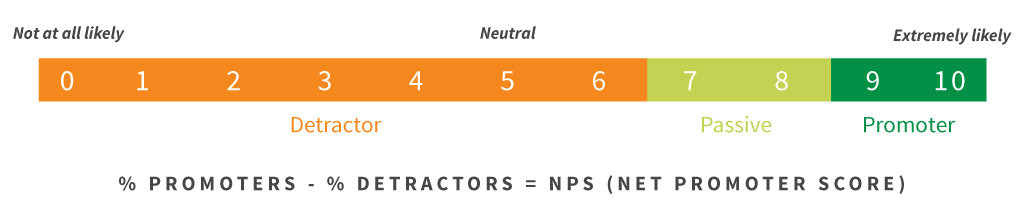
Calculate your NPS using the answer to a key question, using a 0-10 scale: How likely is it that you would recommend [brand] to a friend or colleague?
 
Respondents are grouped as follows:
 

  • Promoters (score 9-10) are loyal enthusiasts who will keep buying and refer others, fueling growth.
  • Passives (score 7-8) are satisfied but unenthusiastic customers who are vulnerable to competitive offerings.
  • Detractors (score 0-6) are unhappy customers who can damage your brand and impede growth through negative word-of-mouth.

 
Subtracting the percentage of Detractors from the percentage of Promoters yields the Net Promoter Score, which can range from a low of -100 (if every customer is a Detractor) to a high of 100 (if every customer is a Promoter).


A Core Metric for CEM

Use your NPS as the key measure of your customers' overall perception of your brand. Because NPS is a leading indicator from growth, it provides the best anchor for your customer experience management (CEM) program. Complement NPS with other metrics and insights from various points along the customer journey, and you have a comprehensive, actionable view of your customer experience performance.


Trusted by Your Workforce

Straightforward and easily understood by everyone from the corner office to the front line, NPS provides a touchstone for engaging your workforce in your customer experience program.

Source: netpromoter

--
--
We are also on Face Book, Click on Like to jois us
FB Page: https://www.facebook.com/pages/Hyderabad-Masti/335077553211328
FB Group: https://www.facebook.com/groups/hydmasti/
 
https://groups.google.com/d/msg/hyd-masti/GO9LYiFoudM/TKqvCCq2EbMJ

---
You received this message because you are subscribed to the Google Groups "Hyderabad Masti" group.
To unsubscribe from this group and stop receiving emails from it, send an email to hyd-masti+unsubscribe@googlegroups.com.
For more options, visit https://groups.google.com/d/optout.

Monday, 14 November 2016

[HM:258547] 9 tricks to appear smart in meetings

The following is an excerpt from Sarah Cooper's new book, 100 Tricks to Appear Smart in Meetings (October 4, Andrews McMeel)

In a brainstorming meeting, the pressure of coming up with incredible new ideas can be debilitating. Luckily, the last thing most corporations want is new ideas.

During these largely pointless exercises, the point is to contribute using the mere gravitas of your presence, make other people's ideas seem like your ideas, and look like a true leader by questioning the efficiency of the whole process.

Here are 9 tricks to make you look like you're the creative force on your team.

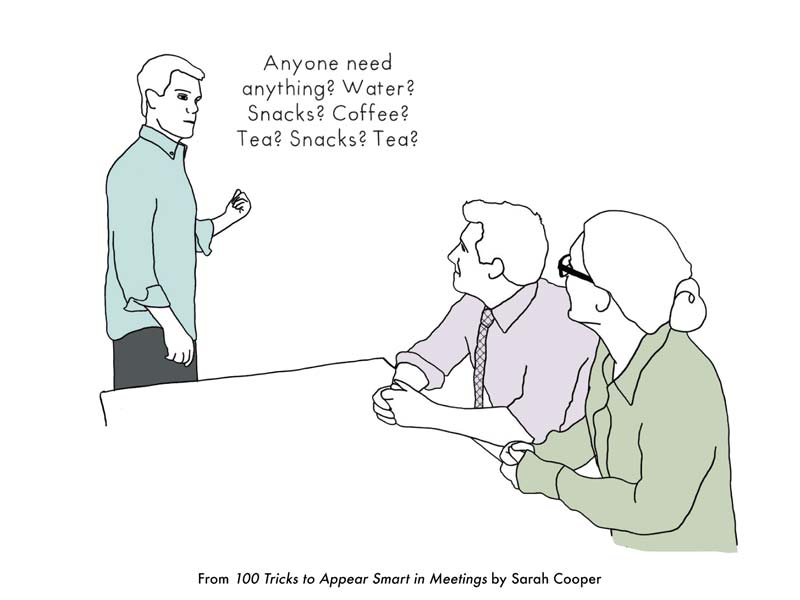
  1. Leave to get water and ask if anyone needs anything

image1-4

Just before the meeting starts, get up and ask if anyone needs anything. People will think you're so thoughtful, kind, and giving, plus you'll be able to disappear for 10 minutes no questions asked. Even if no one wants anything, return with bottles of water, soda, and snacks.

Your colleagues will feel compelled to start drinking and snacking, and your foresight will make them think you can really predict the future.


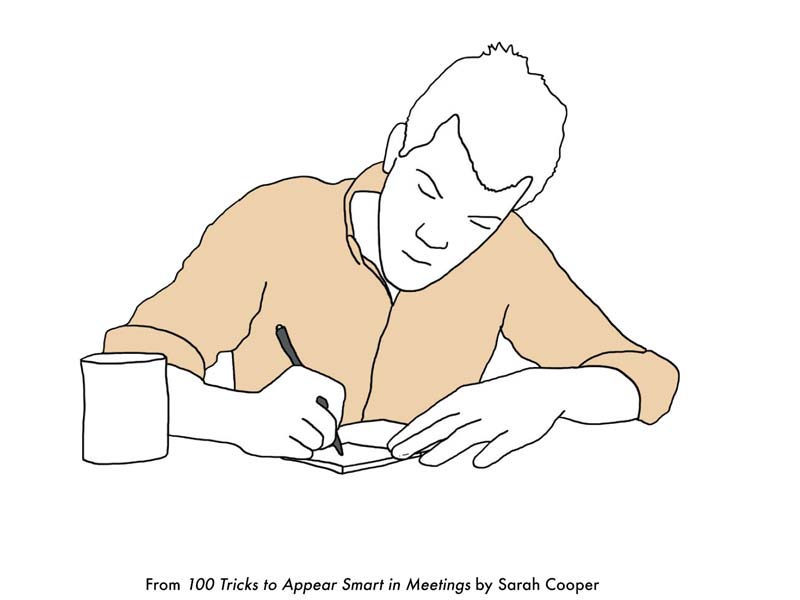
  1. Grab a pad of sticky notes and start drawing

image2-2

While the topics are being introduced, grab one of those sticky note pads and start drawing meaningless flowcharts. Your colleagues will look over at you with worried interest, wondering how you're coming up with so many complex ideas even before you know what this meeting is for.


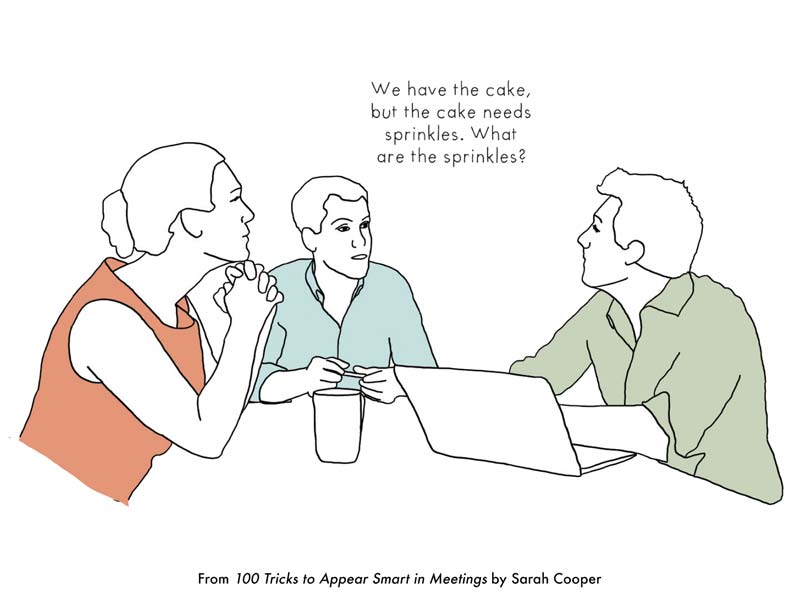
  1. Make an analogy that's so simple it sounds deep

image3

When everyone is trying to define the problem, make an analogy about baking a cake, or something just as completely unrelated. Your colleagues will nod their heads in agreement, even if they really don't understand how what you're saying is related to what they're talking about. Talking completely over their heads will make you seem wildly transcendent and intimidatingly creative, even though the truth is you really just like cake.


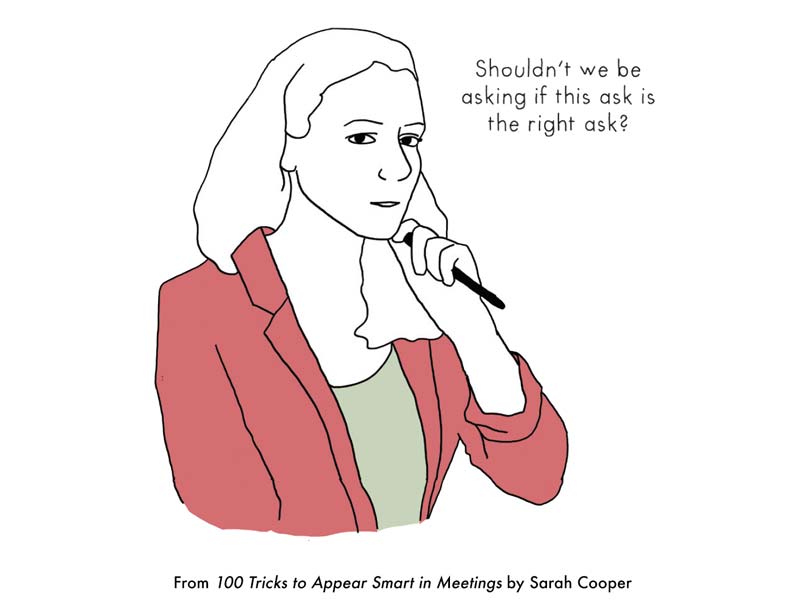
  1. Ask if we're asking the right questions

image4

Nothing makes you seem smarter than when you question the questions by asking if they're the right questions. If someone responds by asking you what you think the right questions are, say you just asked one.


Sidebar: How to strategically shoot down small ideas

Wonder if an idea seems too small so your colleagues see you as a big thinker and a gamechanger.

Use one of these phrases:

  • But how is it disruptive?
  • Is this 10x?
  • Is this the future?
  • I thought that was dead.
  • What's the big Win?
  • But isn't Apple doing that?


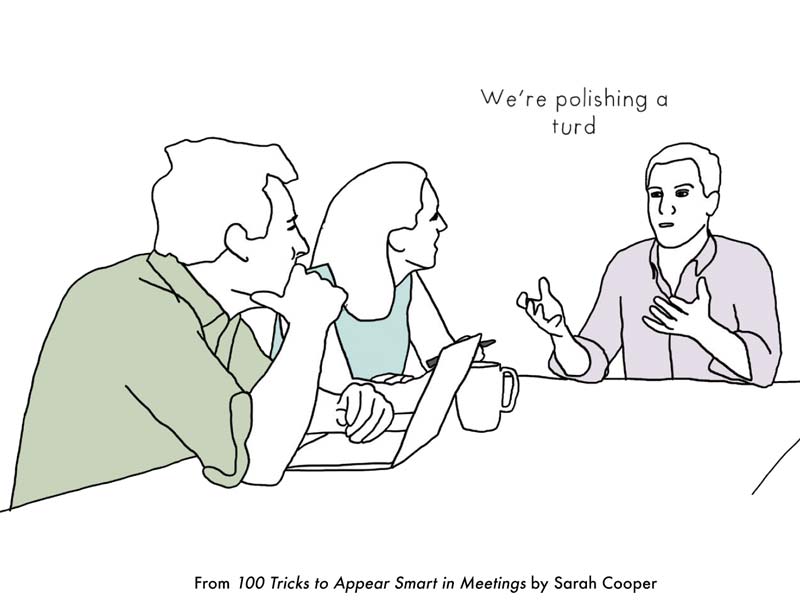
  1. Use an idiom

image5

Using an idiom to question an idea is a subtle, smart way of questioning it. Here are some idioms to choose from:

  • Isn't that gilding the lily?
  • Isn't that putting lipstick on a pig?
  • Seems like we're polishing a turd.


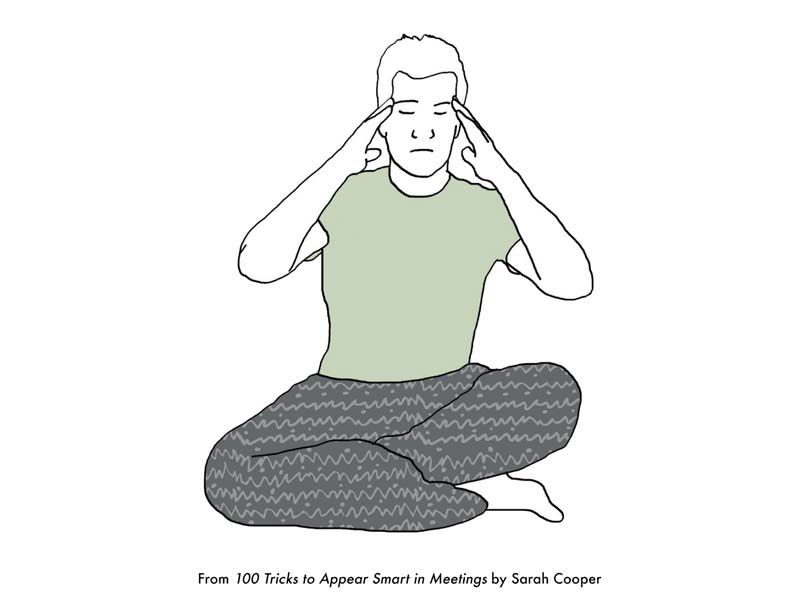
  1. Develop a quirky, creative habit that 'gets your juices flowing'

image6

Develop a quirky habit that 'helps you think' and 'gets your creative juices flowing.' This could be anything from showing up in your pyjamas, meditating on the floor, jogging on the spot, throwing a ball against the wall, air drumming with your favourite drumsticks, or all of those things at the same time. Even if you're not actually coming up with any ideas, your colleagues will be intimidated by your uncontrollable creative energy.


Sidebar: How to strategically shoot down big ideas

Wonder if an idea seems too big so your superiors see how much you care about company resources.

Use one of these phrases:

  • Is it too disruptive?
  • How does this fit into the roadmap?
  • This seems like a pivot.
  • Isn't that a non-starter?
  • Isn't that out of scope?
  • But how would you test that?
  • Will that work internationally?


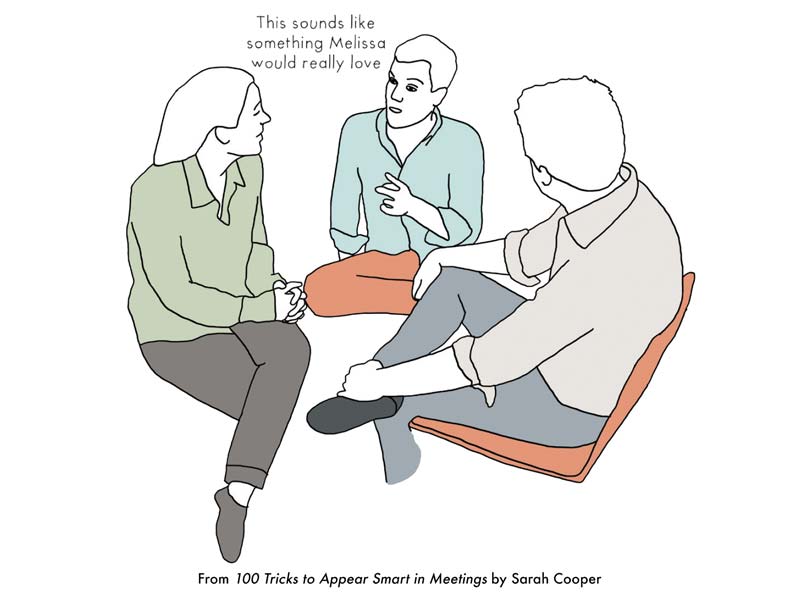
  1. Say how you think the CEO would respond

image7

Make your colleagues think that you have a very close relationship with the CEO by bringing up how you think she would respond to an idea. Mention your CEO by her first name. Say you might run this by her during your next powwow. Congratulate everyone for coming up with something she'd like. By associating yourself so closely with the CEO, people will start to think of you as some kind of CEO-in-training.

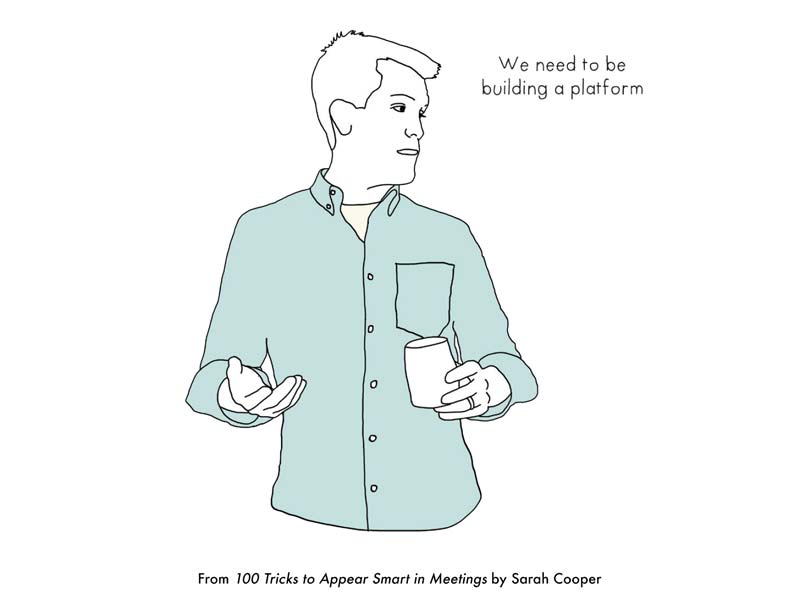
  1. Ask if we're creating the right framework, platform, or model

image8

You will always appear as if you're thinking bigger than everyone else by bringing up a framework for moving forward, or a model of thinking, or how we can turn this into a platform. It's a very meta way of blowing everyone's minds and masking the fact that you have no idea what everyone's talking about.

  1. When everyone seems to like an idea, yell out 'Ship it!'

image9

There'll come a point when everyone seems to be really excited about an idea or direction. At this point you should try to be the first person to yell out 'Ship it!' Sure, it's a funny thing to say that will make people laugh, but doing this will also convey some authority on your part to both end the meeting and make a final decision, even though you have no power to do either.

100 Tricks to Appear Smart in Meetings will be released October 4th. Pre-order it here and read more at 100Tricks.com.


--
--
We are also on Face Book, Click on Like to jois us
FB Page: https://www.facebook.com/pages/Hyderabad-Masti/335077553211328
FB Group: https://www.facebook.com/groups/hydmasti/
 
https://groups.google.com/d/msg/hyd-masti/GO9LYiFoudM/TKqvCCq2EbMJ

---
You received this message because you are subscribed to the Google Groups "Hyderabad Masti" group.
To unsubscribe from this group and stop receiving emails from it, send an email to hyd-masti+unsubscribe@googlegroups.com.
For more options, visit https://groups.google.com/d/optout.
Sunday, 13 November 2016

[HM:258546] Having A Bad Day?


We almost always never see it coming. It crawls up on us like a night thief and ends up stealing our joy the whole day.

Whether it's an unproductive day at work, boring day at school or just waking up on the wrong side of the bed, a bad day can leave you wishing you could fast-forward time.

Since you're not an alien from Jupiter or in possession of a time travel machine, you're better off facing reality.

These tips should set you off in the right path.

Accept The Situation: This might not seem as the best thing to do – since a bad day leaves you in denial. But the more you try to fight the situation, the bigger it comes back attacking you from different angles. Accept the obvious and you'll reduce the extent to which the misfortunes will affect you.

Relax Your Mind: While this might prove impossible at the time when the world seem to be upside down (In your mind), if you eventually manage to get your mind settled, you're two steps towards getting over everything. Listening to good music can get you quickly into a calm state. You can go deeper by meditating.

Confront The Situation: We are often times the engineer behind a bad day. Figuring out the possible reason(s) behind it is arguably the quickest way to putting smile back on your face. Think a little deep about it. Could it have been the extra stress at work? Or as a result of a break up? A bad day could also be caused by pressure or excessive thinking and worrying. If you're able to figure what started it all, pat yourself on the back, you're good to go.

Drink Tea: No, not tea exactly, but if that's what gives you good feeling and takes away negative energy, get on with it. For some, its chocolate, ice cream, alcohol or taking a shower (no pun intended). Do whatever gives you positive vibes and viola – you're good to good.

These are just a few ideas about dealing with a bad day. Hope you don't mind sharing what works for you?

  • Henry Nnaike
source: Sterling

--
--
We are also on Face Book, Click on Like to jois us
FB Page: https://www.facebook.com/pages/Hyderabad-Masti/335077553211328
FB Group: https://www.facebook.com/groups/hydmasti/
 
https://groups.google.com/d/msg/hyd-masti/GO9LYiFoudM/TKqvCCq2EbMJ

---
You received this message because you are subscribed to the Google Groups "Hyderabad Masti" group.
To unsubscribe from this group and stop receiving emails from it, send an email to hyd-masti+unsubscribe@googlegroups.com.
For more options, visit https://groups.google.com/d/optout.